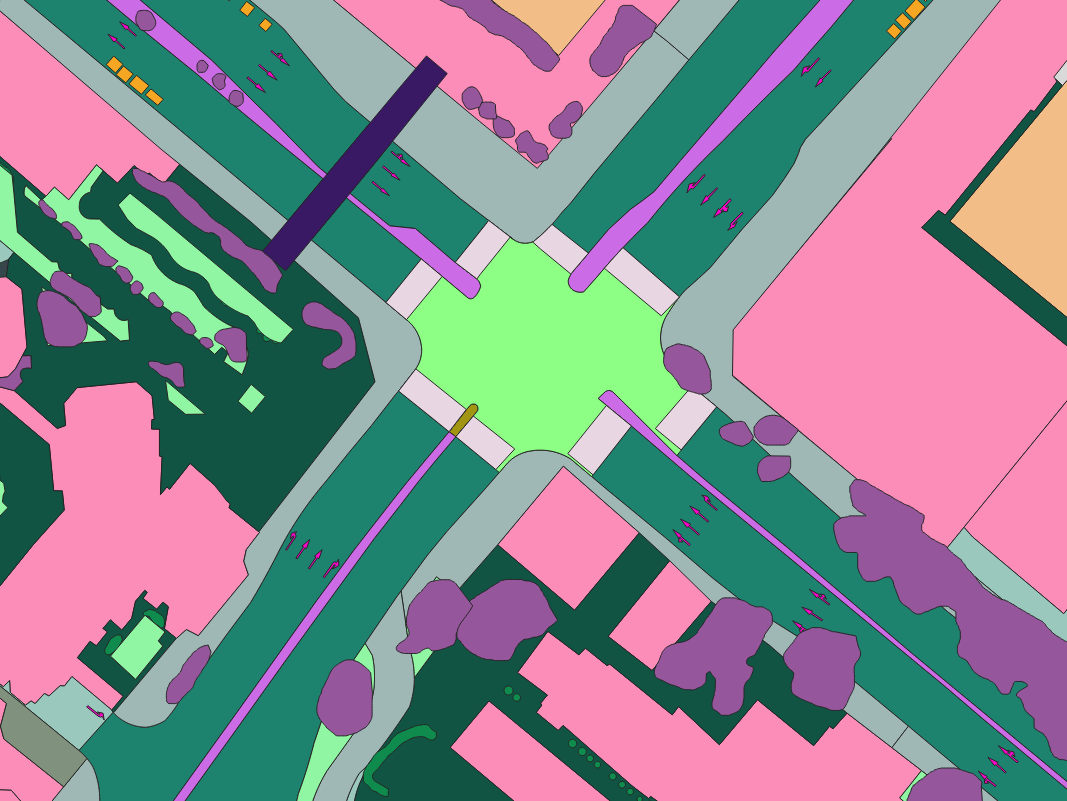
Road Line Classification & Quality Assessment (Case Study)
Location: Germany
Project Overview
Nazru’s AI platform was deployed to classify road line types and pavement markings into detailed categories, assess occlusion (visibility), and evaluate physical quality. This project involved:
Distinguishing temporary yellow lines from permanent white lines
Detecting occlusion (lines covered by shadows, vehicles, debris, or wear)
Rating line quality into three levels: Bad – Medium – Good
Classifying line types (e.g., dashed_line, long_line, small_broken_line, etc.)
Classifying other pavement markings (crosswalk, arrows, stop_line, stop_sign, zones, international signs, words, etc.) based on the provided list
The Challenge
The client needed a comprehensive, automated inventory of all road markings, including both temporary and permanent lines, with precise classification of line patterns (dashed, long, small broken) and other symbols (arrows, signs, crosswalks, restricted zones). Additionally, they required occlusion detection and quality grading to prioritise maintenance. Traditional manual surveys were too slow, inconsistent, and expensive.
The Nazru Solution
Nazru’s platform addressed this challenge by integrating high‑resolution aerial and satellite imagery with proprietary AI models. Our algorithms automatically performed the following:
1. Line colour & permanence classification:
Temporary yellow lines
Permanent white lines
2. Occlusion detection:
Identifying segments where road markings are partially or fully covered
3. Quality assessment (per segment):
Bad: Faded, broken, or barely visible
Medium: Partially visible but still usable
Good: Clearly visible and intact
4. Line type classification:
dashed_line– standard dashed lane lineslong_line– longer dash patterns (e.g., warning lines)small_broken_line– very short broken lines (e.g., turn pockets)(Please add any other line classes you have, such as solid_line, double_solid, etc.)
5. Other pavement marking classification (complete list):
crosswalkno_parking_zoneparking_zonerestricted_areastop_linestop_signstraight_arrowturn_leftturn_left_rightturn_left_straight_rightturn_rightturn_straight_leftturn_straight_rightother_international_signsother_lane-markings_wordstemporary_cancelledthe_rest_of_the_lane_markings
Key Results & Benefits
Complete, up‑to‑date digital inventory of all road markings with 20+ detailed classes
Clear separation of temporary (yellow) vs. permanent (white) lines for construction planning
Occlusion heatmaps showing where markings are hidden and need cleaning or re-evaluation
Quality‑graded maps (bad/medium/good) enabling data‑driven maintenance prioritisation
Fully automated workflow scalable to city‑wide or regional networks
Key Technologies Used
AI‑based semantic & instance segmentation
Colour classification (yellow vs. white)
Pattern recognition for dashed, long, and small broken lines
Occlusion detection using context‑aware models
Quality grading via line integrity and contrast analysis