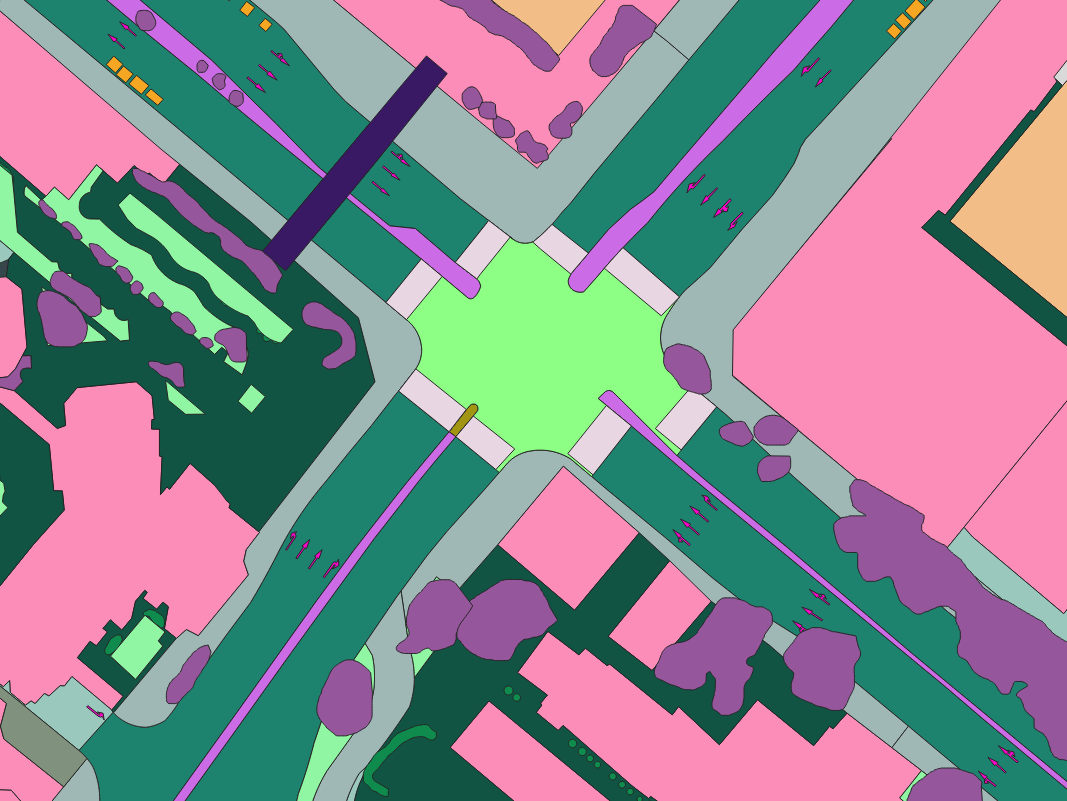
Roadside Infrastructure Detection (Case Study)
Location: Munich, Germany
Project Overview
Nazru’s AI platform was deployed to automatically detect and classify roadside infrastructure elements into five distinct categories: curbstone, fence, guardrail, planar border between paved and unpaved area, and pole. This project provided a comprehensive digital inventory of linear and point features essential for road asset management, safety analysis, and autonomous navigation.
The Challenge
The client lacked an up‑to‑date, spatially accurate map of roadside infrastructure. Manual field surveys were costly, time‑consuming, and often incomplete. There was no automated method to distinguish between different feature types (e.g., curbstone vs. guardrail) or to capture the precise boundary between paved and unpaved surfaces.
The Nazru Solution
Nazru’s platform integrated high‑resolution aerial or mobile mapping imagery with deep learning models. Our algorithms automatically detected and classified the following five feature classes:
Curbstone – raised edges separating roadway from sidewalk or gutter
Fence – barriers alongside roads (e.g., metal, wood, or mesh fences)
Guardrail – impact‑absorbing barriers typically installed on roadside or median
Planar border between paved and unpaved area – transitional boundary where asphalt/concrete meets gravel, soil, or vegetation
Pole – vertical structures such as utility poles, streetlight poles, traffic sign poles, or camera masts
Each detected feature was geolocated and attributed with its class type.
Key Results & Benefits
Complete digital inventory of roadside assets across the road network
Clear classification of five distinct infrastructure types
Accurate mapping of paved/unpaved boundaries for maintenance and drainage planning
Automated workflow reducing manual inspection costs and improving data consistency
Key Technologies Used
AI‑based object detection and segmentation (point, line, and polygon)
Edge detection for curbstone and planar borders
Linear feature extraction for fences and guardrails
Point feature detection for poles
Output Formats: Raster & Vector
All deliverables are provided in both raster and vector formats to support GIS, CAD, web mapping, and AI training.
Raster outputs:
Original and orthorectified high‑resolution imagery
Binary masks for each feature class (curbstone, fence, guardrail, border, pole)
Class‑coloured segmentation maps
Vector outputs:(Shapefile, GeoJSON, KML)
Curbstone – Line geometry
Fence – Line or polygon geometry
Guardrail – Line geometry
Planar border – Line geometry with attribute
type: paved_unpavedPole – Point geometry with pole subtype (if applicable)