3D Building Modelling – Switzerland (Nationwide)
Location: Switzerland
Data sources: High‑resolution aerial imagery (ADS), photogrammetric stereo pairs, optional 2D blueprints
Output format: 3D building models (CityGML, DWG, or custom formats) with LoD (Level of Detail) specifications
Project Overview
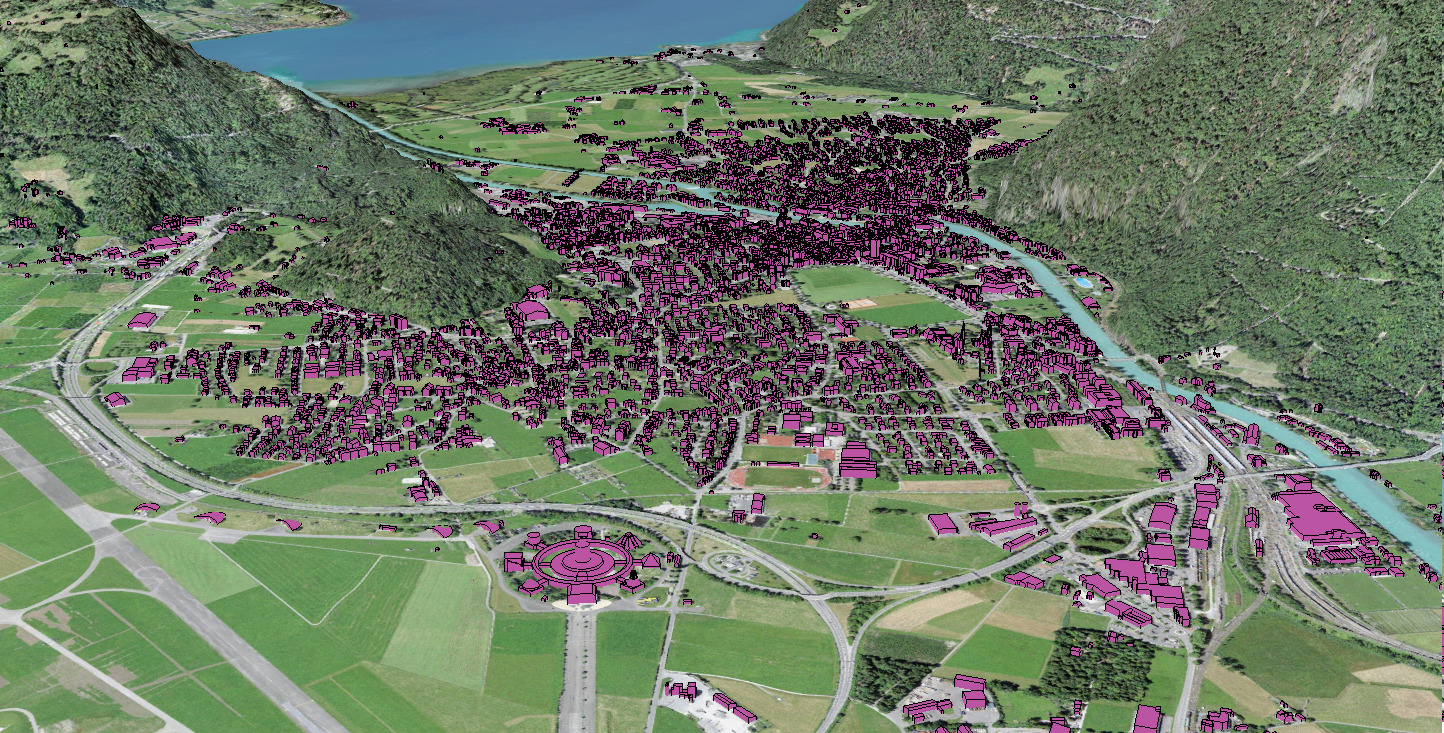
Nazru’s AI platform was deployed to generate 3D building models across Switzerland using high‑resolution aerial imagery and advanced photogrammetric and AI‑based techniques. This project was executed without LiDAR point cloud data; all building geometry extraction was performed using stereo aerial imagery and deep learning algorithms. The final outputs include 3D models in CityGML and DWG formats, suitable for urban planning, environmental analysis, and digital twin applications.
The Challenge
Modelling 3D buildings across Switzerland without LiDAR data presents several challenges:
Height extraction from aerial imagery – Unlike LiDAR, which directly measures elevation, building heights must be derived from stereo image correlation between overlapping aerial photographs, requiring high‑accuracy matching algorithms.
Edge and occluded line detection – In aerial imagery, some building edges (especially on rooftops or in shadowed areas) may be difficult to detect.
Cloud and shadow interference – Aerial imagery can be affected by cloud cover and shadows, which impact geometric extraction accuracy.
Complex roof geometries – Automated extraction of complex roof types (e.g., mansard, multi‑ridge, or overhanging roofs) requires advanced deep learning models.
Multi‑LoD requirements – Different applications require different Levels of Detail, from simple block models (LoD1) to detailed architectural models (LoD2+) with roof structures and facades.
The Nazru Solution
Nazru’s platform combines high‑resolution aerial imagery with state‑of‑the‑art AI algorithms to deliver a complete 3D building modelling workflow without the need for LiDAR data:
1. Data Acquisition & Pre‑processing
ADS aerial imagery – High‑resolution aerial photo strips (typically 10–25 cm GSD) serve as the base data.
Stereo correlation – Automated matching between overlapping aerial image pairs to generate a Digital Surface Model (DSM) and Digital Terrain Model (DTM).
Atmospheric and geometric correction – Removal of atmospheric effects and correction of geometric distortions.
2. AI‑Powered Feature Extraction
Building detection & segmentation – Deep learning models (e.g., U‑Net, DeepLabV3+) are used to extract precise building footprints from aerial imagery.
Roof line extraction – Ridge lines, eaves, and roof planes are detected using convolutional neural networks.
Roof type classification – Automatic identification of roof types (gable, hip, flat, mansard, etc.) from image features.
3. 3D Reconstruction
Block model generation (LoD1) – Based on building footprints and average height derived from the DSM.
Roof‑enabled model generation (LoD2) – Using extracted roof lines and height points for ridges and eaves.
Facade reconstruction (optional, LoD3) – When required, using oblique aerial imagery.
4. Attribute Enrichment
EGID integration – Each building model is structured according to the federal building identifier (EGID), enabling linkage with cadastral and property databases.
Additional attributes – Building height, number of storeys, usage type, and construction period (where available).
5. Output Generation
CityGML 2.0 format – Standardised exchange format combining 3D geometry with semantic attributes (EGID, building type, etc.).
DWG format – Grouped by roofs, facades, and footprints for CAD workflows.
Key Results & Benefits
Nationwide coverage – Every building in Switzerland and Liechtenstein is modelled in 3D.
Lower cost – Eliminates the need for expensive LiDAR data acquisition, reducing overall project costs.
Acceptable accuracy – With high‑resolution aerial imagery, sub‑metre accuracy is achievable for building geometry.
Multiple applications – Urban planning, shadow and solar potential analysis, disaster simulation, energy renovation, and interactive 3D visualisation.
Interoperability – CityGML output ensures compatibility with GIS, BIM, and urban modelling software.
Scalable and updateable – The dataset can be updated canton by canton as new aerial imagery becomes available.
Key Technologies Used
Photogrammetric stereo correlation – For DSM generation and building height extraction.
Deep learning for building segmentation – U‑Net, DeepLabV3+, or Swin Transformer architectures.
Roof detection & classification – AI models trained on Swiss building typologies.
Image‑based 3D reconstruction – Photogrammetric and computational geometry algorithms.
CityGML and 3D Tiles – For standardised data exchange and web visualisation.
Output Format
Primary outputs:
CityGML 2.0 – Semantic 3D building models with EGID attributes.
DWG – CAD‑ready geometry grouped by roofs, facades, and footprints.
3D Tiles – For web‑based interactive visualisation.
Attribute table (CityGML format):
EGID– Federal building identifier (unique per building)building_type– Classification (residential, commercial, industrial, etc.)building_height– Height derived from DSMroof_type– Gable, hip, flat, mansard, etc.storeys_above_ground– Number of floors (if available)construction_year– (where available)